

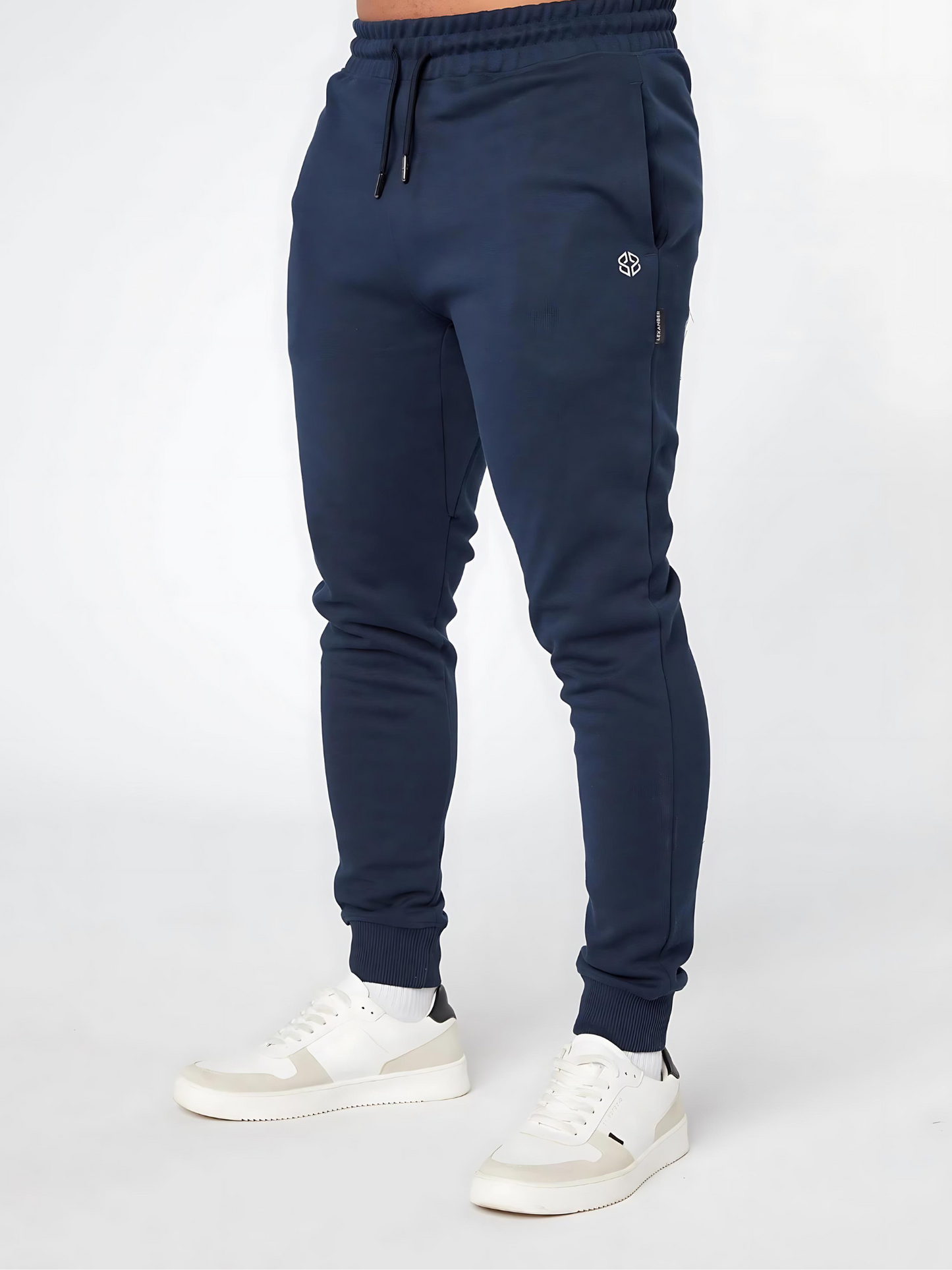
Most joggers don't fit properly — not because you bought the wrong size, but because you were never told what "properly" actually looks like. The waist sits too low. The thigh bunches. The cuff pools at your ankle like a puddle of fabric. And every time you look in the mirror, something feels off — you just can't name it. That ends today.
Quick answer: A well-fitting jogger sits comfortably on the natural waist without needing the drawstring cinched tight, tapers cleanly through the thigh and knee without pulling or bagging, and ends with the cuff sitting at or just above the ankle bone — never pooling on the shoe. As a rule, if you can grip more than 2 inches of loose fabric at the thigh, calf, or ankle, size down. If the waist has to be cinched to stay up, size down. If the crotch seam pulls when you sit, size up.
In this guide, we'll walk you through the 6 fit rules that separate premium-fitting joggers from disposable ones, teach you the "2-inch test" to check your own pair, cover exactly how to measure yourself for the Lexanber size chart, and diagnose the 6 most common fit problems with real solutions.
Why Jogger Fit Matters More Than Any Other Trouser
Denim forgives bad fit. Chinos hide it. Formal trousers correct it with a tailor.
Joggers expose it.
The jersey-knit construction that makes joggers comfortable is also unforgiving — every wrinkle, sag, and bunch is visible. The soft fabric drapes to your body precisely, which means the right size looks tailored and the wrong size looks lazy. That's why two people wearing the same brand of joggers can look completely different: one nailed the fit, one didn't.
The good news: getting jogger fit right isn't hard. It's just six rules.
The 6 Rules of How Joggers Should Fit
Rule 1: The Waist Sits on Your Natural Waist (Without Needing the Drawstring)
Your waistband should sit comfortably on your natural waist — roughly one inch above your hip bones — and stay there without the drawstring being cinched tight.
Two easy tests:
- The pull test: Grip the waistband and gently pull down. If it slides down more than an inch without effort, the waistband is too loose — size down.
- The drawstring test: Take the drawstring completely out of the way (untie it, tuck it in). If the joggers stay up comfortably without it, the waist fits. If they start to slide down, they're too big.
A well-designed waistband — like the ribbed elasticated construction on the Lexanber Men's Slimfit Jogger and Women's Slimfit Jogger — should feel snug but not tight, with the drawstring as a comfort adjustment rather than a structural necessity.
Rule 2: The Thigh Is Slim But Not Tight
The thigh is where slim-fit joggers earn their name. The fabric should follow the shape of your leg with about half an inch of ease all the way around — enough to move comfortably, not so much that it bags.
The pinch test: Standing straight, pinch a fold of fabric on the outside of your thigh. If the fold is:
- Under 1 inch — the fit is slim and correct
- 1 to 2 inches — the fit is regular; still acceptable if you prefer more room
- Over 2 inches — the joggers are too loose; size down
The stress test: Do a bodyweight squat. If the thigh fabric pulls tight or restricts the movement, the joggers are too small. If it stays in place with no strain — you're in the right size.
Rule 3: The Knee Follows Your Leg Line
The knee area of a well-fitting jogger continues the gentle taper from thigh to calf. There should be no obvious "knee panel" bag or bunch — the fabric follows your leg smoothly.
What goes wrong here: Cheap joggers often have thigh room that's disproportionate to the knee, so when you stand, a visible pouch forms at the knee. Premium joggers with proper pattern grading — cut individually for each size — don't have this problem.
If your joggers have a knee bag or pouch, the pattern was scaled up from a smaller base size rather than graded properly for your size. Fixing it means switching brands, not sizes.
Rule 4: The Cuff Sits at or Just Above the Ankle Bone
This is the single most visible fit rule — and the one most people get wrong.
The correct position: The bottom of the ribbed cuff should sit at your ankle bone or up to 1 inch above it. Not lower. Not higher.
- Cuff too low (pooling on the shoe) → joggers are too long or too baggy. Size down, or choose a slimmer cut.
- Cuff too high (halfway up the calf) → joggers are too short. Size up, or choose a different length.
- Cuff at ankle bone, sitting cleanly → correct fit.
The Lexanber slim-fit joggers — including the Women's Slim Fit Jogger in Sage Green — are engineered to hit this exact position on a properly-sized wearer, with the ribbed cuff providing a clean break above chelsea boots, loafers, or trainers.
Rule 5: The Rise Depth Matches Your Torso
The rise is the distance from the crotch seam up to the top of the waistband. Get it wrong, and no size feels right.
- Rise too shallow (low-rise) → the waistband won't stay on your natural waist; it'll slide down onto your hips, and the crotch seam will sit uncomfortably. Common in fast-fashion joggers designed for younger bodies.
- Rise too deep (high-rise) → the waistband will sit above your natural waist, creating a "mom fit" silhouette and a saggy crotch area.
- Rise correct (mid-rise) → the waistband sits at your natural waist, the crotch seam sits comfortably at your body without pulling or bagging.
How to test: With your joggers on, look down at the front. The crotch seam should sit at your body with roughly 1–2 inches of vertical space between the seam and your actual crotch. If it's tight against your body, the rise is too short. If there's 4+ inches of loose fabric hanging down, the rise is too long.
Rule 6: The Overall Length Ends at the Ankle Bone (No Pooling)
Length is separate from cuff position — length is about how much fabric is in the leg overall. Too much fabric, even with the correct cuff position, will bunch above the cuff and read as sloppy.
The pinch test for length: Stand with your joggers on. Pinch the fabric on the front of your shin, halfway between your knee and cuff. If there's more than 1 inch of loose fabric to pinch, the leg is too long — size down or hem.
Premium slim-fit joggers are cut with proportional length grading so that a size M jogger has an inseam suited to a size M person, not just a shorter version of an XXL pattern.
The 2-Inch Test: A 30-Second Fit Check
If you don't have time to work through all six rules, run this single check on any pair of joggers you own or are trying on:
Pinch a fold of fabric at three points:
- The outside of your thigh (mid-thigh)
- The outside of your calf
- The front of your ankle, just above the cuff
If any of those folds are more than 2 inches — the joggers are too big. Size down. It's that simple.
If any of those folds are less than half an inch and the fabric feels tight or restrictive — the joggers are too small. Size up.
If the folds are between half an inch and 2 inches at all three points — the fit is correct.
This test works because it's the same measurement premium designers use during pattern-grading. It bypasses subjective terms like "slim" or "regular" and gives you a concrete answer.
How to Measure Yourself for the Lexanber Size Chart
Every Lexanber PDP includes a size chart with specific measurements — but the chart only helps if you're measuring yourself correctly. Here's how.
You'll Need:
- A soft measuring tape (not a rigid ruler)
- Your usual undergarments (measure over them, not over trousers)
- A mirror or a friend to check the tape stays level
The 4 Measurements That Matter
1. Waist (natural waist, not trouser waist)
Your natural waist is the narrowest point of your torso — roughly 1 inch above your belly button. Wrap the tape around this point, keep it parallel to the floor, and note the measurement in inches and centimetres.
This is the measurement to prioritise for jogger sizing.
2. Hip (widest point)
Wrap the tape around the widest part of your hips — usually 7–9 inches below the waist. Keep the tape level. Note the measurement.
If your hip measurement is a size larger than your waist measurement on the size chart, choose the hip size — the waistband will adjust with the drawstring.
3. Inseam (crotch to ankle)
Stand straight, hold the tape at your inner crotch seam (where a pair of well-fitting trousers would meet), and measure straight down to your ankle bone. This is your inseam length.
Compare against the Lexanber jogger inseam length for your size. If your inseam is:
- Within ±1 inch of the chart — the length will fit correctly
- More than 2 inches shorter — the joggers will pool at the ankle; consider a slimmer cut or expect to hem
- More than 2 inches longer — the cuff will sit too high; consider sizing up in length
4. Thigh circumference (optional but useful)
Wrap the tape around the widest part of your thigh (roughly 4 inches below the crotch). This isn't on most jogger size charts, but knowing it helps you diagnose whether the "slim" cut of a jogger will fit your body — if your thigh circumference is 1–2 inches larger than what a slim-fit jogger typically accommodates, choose a regular-fit cut instead.
Which Measurement to Prioritise
If your waist and hip measurements fall into different sizes on the chart:
- For men, prioritise waist measurement — the elasticated waistband adjusts easily to smaller hips
- For women, prioritise hip measurement — hip fit is harder to adjust than waistband cinching
If your inseam falls into a different size, prioritise waist/hip and expect to either accept the length as-is or hem if needed.
6 Common Jogger Fit Problems (And How to Fix Them)
Problem 1: My joggers pool at the ankle
Cause: Length is too long, OR the cuff isn't tight enough to stay in position. Fix: Size down, choose a slimmer cut, or have a tailor shorten and re-band the cuff (£15–£25 in most UK alteration shops).
Problem 2: The crotch seam sags between my legs
Cause: Rise depth is too long for your torso, OR the joggers are one size too big overall. Fix: Size down. Rise depth is a pattern issue, not a fabric issue — sizing down usually solves both proportions.
Problem 3: The thigh feels tight but the waist is loose
Cause: You've bought a size that fits your waist but not your build. Your thighs are wider than what that size accommodates. Fix: Size up and use the drawstring to cinch the waist. Alternatively, choose a regular-fit or relaxed-cut jogger from the same brand.
Problem 4: The waistband slides down every time I move
Cause: Waist size is too big, OR the waistband elastic has fatigued from washing. Fix: For new joggers, size down. For older joggers where the elastic has died, replace them — premium waistbands should hold shape for 100+ washes, but cheap elastic dies within 20 washes.
Problem 5: The cuff is too tight and cuts off circulation
Cause: The cuff rib is undersized for your calf circumference. Rare in premium brands, common in fast-fashion. Fix: Size up — but this often means the rest of the joggers become too big. Better to switch brands to one with a wider cuff opening.
Problem 6: The joggers look great standing but the crotch pulls when I sit or squat
Cause: The rise or thigh is too tight for full-body movement. Fix: Size up. Premium joggers are designed to move with you — a proper fit doesn't require you to stand rigidly to look right.
Slim-Fit vs Regular Fit vs Baggy — Which Is Right for You?
The "fit" naming on jogger product pages describes the cut, not the size. Here's what each means:
Slim-Fit (Recommended for Styling)
- Close to the body through the thigh and knee, tapering to a snug cuff
- Best for: layering under coats, wearing with hoodies, styling with any footwear, versatile everyday use
- Best silhouette for: most body types (flatters both slim and athletic builds)
- The Lexanber slim-fit jogger range sits in this category
Regular Fit
- Some ease through the thigh and knee, standard cuff
- Best for: comfort priority, older wearers who prefer more room
- Best silhouette for: broader thighs where slim-fit feels restrictive
Relaxed / Baggy / Oversized
- Loose through the entire leg, wide cuff or open hem
- Best for: streetwear-forward looks, gorpcore, techwear aesthetic
- Best silhouette for: intentional stylistic choice, not general use
- The trade-off: harder to style with anything other than chunky trainers
The honest recommendation: Unless you're specifically going for an oversized streetwear look, slim-fit is the more versatile choice. A slim-fit jogger works with hoodies, oxford shirts, overcoats, chelsea boots, and loafers. A baggy jogger works with fewer combinations.
When to Size Up and When to Size Down
Being between sizes on the chart is more common than most brands admit. Here's when to go each direction:
Size UP if:
- Your thigh circumference is at or near the upper limit of your usual size
- You prioritise comfort and full-range movement over silhouette
- You plan to wash the joggers hot (they'll shrink slightly)
- Your body proportions favour hips wider than waist by more than one size
Size DOWN if:
- You want the sharpest slim-fit silhouette
- You always cinch the drawstring on your current joggers
- You prefer joggers that feel structured against your body
- Your body proportions favour waist wider than hips
Stay TRUE to size if:
- Your measurements fall cleanly into one size across waist, hip, and inseam
- You want the fit as designed (which is the default for most Lexanber wearers)
Men's vs Women's Joggers: The Fit Differences
Men's and women's joggers aren't just sized differently — they're patterned differently.
Men's slim-fit joggers (like the Lexanber Men's Slimfit Jogger in Dark Blue) are cut with:
- Straighter overall shape (less curve at the hip)
- Slightly deeper rise
- More thigh room proportional to waist
- Typically a 72% cotton / 28% polyester blend for structure and shape retention
Women's slim-fit joggers (like the Lexanber Women's Slimfit Jogger in Sage Green) are cut with:
- More curve through the hip and thigh
- Slightly shallower rise (sits at natural waist without being high-rise)
- A more tapered cuff for a closer silhouette at the ankle
- Typically a 96% cotton / 4% elastane blend for stretch recovery
Can women wear men's joggers (or vice versa)? Yes, but the fit will feel different. Women wearing men's joggers should expect more straight-line shape through the hip and thigh. Men wearing women's joggers should expect more taper and less room through the seat — which some prefer.
Frequently Asked Questions
How tight should joggers be?
Joggers should be slim enough to follow your body's shape without pulling or restricting movement. The fabric should have about half an inch of ease around the thigh and calf — snug but not skin-tight. If the fabric pulls white when you squat, the joggers are too tight. If you can grip more than 2 inches of loose fabric, they're too loose.
Where should joggers sit on your waist?
Joggers should sit on your natural waist — roughly 1 inch above your hip bones, at the narrowest point of your torso — without needing the drawstring cinched tight. If the waistband slides down when you walk, the size is too big. If the waistband is cinched hard enough to bunch the fabric, the size is too small.
Should joggers pool at the ankle?
No. A well-fitting jogger should end with the cuff sitting at or just above your ankle bone, with the fabric cleanly tapered above it. Pooling fabric at the ankle means the joggers are either too long, too baggy through the leg, or both. Size down or choose a slimmer cut to fix it.
Are slim-fit joggers meant to be tight?
No. Slim-fit describes the cut, not the tightness. A slim-fit jogger follows the shape of your leg with about half an inch of ease throughout — you should be able to squat, sit, and walk normally without feeling restricted. Slim-fit joggers that feel tight are usually a size too small.
What is the difference between slim-fit and tapered joggers?
The terms overlap but describe different things. Slim-fit describes the cut through the entire leg — close to the body from waist to ankle. Tapered describes the shape of the leg, specifically that it narrows from thigh to cuff. The best premium joggers are both slim-fit and tapered — like the Lexanber slim-fit range — which gives a clean, tailored silhouette that flatters every body type.
How do I know if my joggers fit properly?
Run the 2-inch test: pinch a fold of fabric at your mid-thigh, calf, and ankle. If any fold is more than 2 inches, they're too big. If any fold is less than half an inch and the fabric feels tight, they're too small. If all three folds sit between half an inch and 2 inches, the fit is correct.
Should joggers be one size bigger for comfort?
Not usually. Sizing up creates the "sagging jogger" problem — the waist slides down, the crotch bags, and the whole silhouette looks lazy. If you want more comfort, choose a regular-fit or relaxed cut in your correct size rather than sizing up in a slim-fit cut. Premium joggers in your true size are designed to be comfortable while looking right.
Do joggers stretch with wear?
Yes, slightly. Cotton-rich joggers relax by 3–5% during the first few wears as the fibres settle. Joggers with elastane (like Lexanber's women's range) recover more consistently, while pure-cotton joggers tend to stay in the stretched state until they're washed. Buy for the fit as tried, not for how they might loosen — the difference is usually less than half a size.
Final Word
Getting jogger fit right isn't about spending more or trying on ten pairs — it's about knowing the six rules and running them against whatever you're buying. Once you can look at a jogger and read the fit in five seconds, every future pair you buy is a confident purchase, not a hopeful one.
The rules are the same across every brand: waist on the natural waist, thigh with half-an-inch ease, no knee bag, cuff at the ankle bone, matched rise depth, no pooling.
Ready to find your Lexanber size? Browse the Lexanber slim-fit jogger collection — premium cotton-rich fabric, tapered tailored cuts, individually graded from XS to XXL. Every product page includes a detailed size chart with waist, hip, and inseam measurements. And with free UK shipping and free returns, trying your first pair is risk-free.
For more on styling and quality:
- How to Style Joggers: 8 Outfits That Don't Look Lazy — head-to-toe looks built for real UK wardrobes